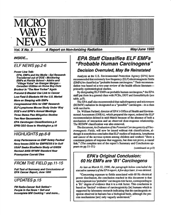
A Report on Non-Ionizing Radiation

News & Comment

Small Group Will File Minority Opinion

Friday, June 3, 2011

It's not easy to reach unanimous agreement on anything to do with cell phone radiation. And when it comes to cell phones and cancer, forget about it. But the International Agency for Research on Cancer (IARC) nearly pulled it off. On Tuesday, May 31, more than two dozen scientists and doctors from 14 countries —a group IARC Director Christopher Wild called "the world's leading experts"— issued a joint statement that cell phone and other types of radiofrequency (RF) and microwave radiation might cause cancer.

Tuesday, May 31, 2011

A day-by-day blog of the IARC RF–Cancer Review, May 23-30.

Sunday, May 22, 2011

The International Agency for Research on Cancer (IARC) has removed Anders Ahlbom of the Karolinska Institute from its panel of experts which is set to evaluate the cancer risks posed by mobile phones. The committee will meet in Lyon, France, for a week beginning this coming Tuesday, May 24. In an e-mail sent out earlier today, Ahlbom wrote, "IARC has excluded me from the RF Working Group because of 'possible perception of conflict of interest'."

Thursday, May 19, 2011

A hard-hitting documentary aired on French television last night alleges that René de Seze, a well-known member of the French RF community, worked to delay, if not bury, a study that would be detrimental to the mobile phone industry. The 90-minute show reports that de Seze coordinated a study on behalf of Bouygues Telecom, a leading cell phone operator, and when the results supported a radiation health risk, he did everything he could to discredit it. De Seze works for French National Institute for the Industrial Environment and Hazards (INERIS).

Monday, April 18, 2011

Chinese researchers in Beijing are seeing some of the highest rates of cancer ever reported in any cell phone study. They have found that long-term, heavy users have rates of malignant parotid gland tumors that are seven to 13 times higher than might otherwise be expected.

Pages

Short Takes

April 19, 2013

The International Agency for Research on Cancer (IARC) has released its detailed evaluation of the cancer risks associated with RF radiation, which serves as the rationale for designating RF as a possible human carcinogen.

The IARC monograph comes close to two years after an invited panel of experts from 14 countries reached this conclusion following an eight-day meeting at IARC headquarters in Lyon, France (see our...

March 29, 2013

Today, the FCC —finally— issued a package of rules and requests for information related to RF health and safety. We say finally because the commission announced that this was on its way last June (see "What's Up at the FCC?"). No one at the FCC is eager to say why it took so long, except that it covers a lot of ground.

The document is indeed long (over 200 pages) and...

December 4, 2012

Another in our continuing series  —Nothing Ever Really Changes. 

We recently came across an item in the January 20, 1964 issue of Newsweek titled, "The Mrs. G Effect" about a California housewife, who could hear noises that no one else could hear.

An "expert" was brought in. As far as he could tell, Mrs. G was converting alternating current fields into sound signals "as though she were a radio receiver." Newsweek also talked to Allan Frey who offered qualified support. "If you use the correct frequency and modulate it properly, it's easy to induce...

November 30, 2012

EPRI, the research arm of the electric utility industry, has just published what might be a very useful report. Unfortunately, most of us will never get to see it.

The report is an evaluation of consumer-grade RF exposure meters —the type of instrument you might use to measure radiation levels from a cell tower or a smart meter. In a short abstract, which is publicly available, EPRI states, "Consumers need to recognize that each [RF...