A Report on Non-Ionizing Radiation

News & Comment

Wednesday, March 23, 2011

The International Agency for Research on Cancer (IARC) has invited three industry operatives to sit in on its weeklong assessment of the cancer risks associated with exposure to wireless radiation and other sources of RF/microwave radiation. Representatives from CTIA, the Wireless Association, the Mobile Manufacturers Forum (MMF) and the GSM Association will all be allowed to attend the IARC review. The meeting will be held in Lyon, France, May 24-31.

Tuesday, March 8, 2011

"Cell Phones Affect Brain Activity." That headline has appeared all over the world since Nora Volkow published a PET scan of a brain lit up by a cell phone last month. Her colorful graphics, published in the high impact Journal of the American Medical Association (JAMA), guaranteed Volkow a large and attentive audience. But all the hoopla shouldn't obscure the fact that for more than a decade many others, notably Peter Achermann's group at the University of Zurich, have shown similar types of radiation-induced changes in the brain as well as much more.

Low-Level Effects Get a Boost

Tuesday, February 22, 2011

A well-regarded and influential team of researchers from the National Institutes of Health (NIH) and the Brookhaven National Lab (BNL) is on the brink of resolving a long-standing dispute with enormous implications for public health. In a paper due out tomorrow, Nora Volkow and coworkers are reporting that cell phone radiation can affect the normal functioning of the human brain.

Whether these short-term changes will lead to health consequences (and what they might be) is far from clear — though Volkow already has preliminary indications of a long-term effect. Nor is the mechanism of interaction yet known. But the new finding, if confirmed, would at the very least force a rethink of the prevailing orthodoxy, which maintains that low levels of RF and microwave radiation are too weak to have any effect and can be disregarded.

Tuesday, December 21, 2010

It's only a short letter buried in the back pages of a journal, but it could change the entire cell phone–cancer controversy.

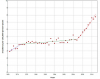
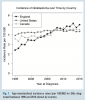
A group at Hebrew University in Jerusalem has reported a sharp increase in the incidence of parotid gland tumors in Israel over the last 30 years. Rakefet Czerninski, Avi Zini and Harold Sgan-Cohen found that these tumors have quadrupled since 1970, "with the steepest increase" after 2001 (see plot below). Their letter appears in the January 2011 issue of Epidemiology; it's a free download. They are with the Hadassah School of Dental Medicine at the university.

Wednesday, December 15, 2010

John Snow is known as the father of modern epidemiology, best remembered for helping end the 1854 cholera epidemic in London. At the time no one yet knew that cholera is caused by bacteria, but Snow had long suspected that it was transmitted by food or water. In the hard-hit neighborhood of Soho where hundreds had died, Snow mapped the location of the homes of the victims and could see that most lived near the Broad Street water pump (see image below). Snow was able to persuade local officials to remove the handle of the pump and soon the epidemic subsided.

Pages

Short Takes

April 19, 2013

The International Agency for Research on Cancer (IARC) has released its detailed evaluation of the cancer risks associated with RF radiation, which serves as the rationale for designating RF as a possible human carcinogen.

The IARC monograph comes close to two years after an invited panel of experts from 14 countries reached this conclusion following an eight-day meeting at IARC headquarters in Lyon, France (see our...

March 29, 2013

Today, the FCC —finally— issued a package of rules and requests for information related to RF health and safety. We say finally because the commission announced that this was on its way last June (see "What's Up at the FCC?"). No one at the FCC is eager to say why it took so long, except that it covers a lot of ground.

The document is indeed long (over 200 pages) and...

December 4, 2012

Another in our continuing series  —Nothing Ever Really Changes. 

We recently came across an item in the January 20, 1964 issue of Newsweek titled, "The Mrs. G Effect" about a California housewife, who could hear noises that no one else could hear.

An "expert" was brought in. As far as he could tell, Mrs. G was converting alternating current fields into sound signals "as though she were a radio receiver." Newsweek also talked to Allan Frey who offered qualified support. "If you use the correct frequency and modulate it properly, it's easy to induce...

November 30, 2012

EPRI, the research arm of the electric utility industry, has just published what might be a very useful report. Unfortunately, most of us will never get to see it.

The report is an evaluation of consumer-grade RF exposure meters —the type of instrument you might use to measure radiation levels from a cell tower or a smart meter. In a short abstract, which is publicly available, EPRI states, "Consumers need to recognize that each [RF...