A Report on Non-Ionizing Radiation

News & Comment

Tuesday, January 20, 2004

Environmental Health Perspectives is now an open access journal. This means that all research articles in EHP, which is published by the NIEHS, are feely accessible on the Internet.

Among the more than 10,000 research reports now available is the startling paper by the Lund University group in Sweden showing that very weak GSM mobile phone radiation can cause leakage through the blood-brain barrier, leading to neurological damage. The  Lund paper appeared in EHP’s June 2003 issue and was posted on the Web last January (see MWN, J/F03). The studies on the blood-brain barrier by Lund’s Drs. Leif Salford and Bertil Persson prompted a workshop held in Germany in November. Microwave News was there and we will be posting a report on the meeting soon.

Tuesday, January 20, 2004

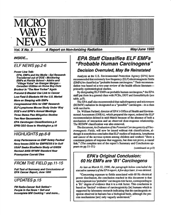
Today it may be more of historical than scientific interest, but EPA’s 1990 evaluation of EMF cancer risks is now available on the Internet at no charge.

Back then, the draft Evaluation of the Potential Carcinogenicity of Electromagnetic Fields was a hot item. A team led by Dr. Robert McGaughy had recommended that power-frequency EMFs should be classified as “probable human carcinogens” and that RF/MW radiation be considered a “possible human carcinogen.”

Saturday, July 1, 1995

The irony is astonishing. On the very day that a committee of the National Council on Radiation Protection and Measurements (NCRP) completed its 800-page draft report asking regulatory agencies to pay "serious attention" to EMFs, public television station WGBH aired a one-hour show across the country comparing EMFs to cold fusion. While the NCRP committee called for "a national commitment to further research," the June 13 Frontline,"Currents of Fear," asked whether it was time to close down the research effort.

Pages

Short Takes

April 19, 2013

The International Agency for Research on Cancer (IARC) has released its detailed evaluation of the cancer risks associated with RF radiation, which serves as the rationale for designating RF as a possible human carcinogen.

The IARC monograph comes close to two years after an invited panel of experts from 14 countries reached this conclusion following an eight-day meeting at IARC headquarters in Lyon, France (see our...

March 29, 2013
Last udated June 4, 2013

Today, the FCC —finally— issued a package of rules and requests for information related to RF health and safety. We say finally because the commission announced that this was on its way last June (see "What's Up at the FCC?"). No one at the FCC is eager to say why it took so long, except that it covers a lot of ground.

The document is indeed long (over 200 pages) and...

December 4, 2012

Another in our continuing series  —Nothing Ever Really Changes. 

We recently came across an item in the January 20, 1964 issue of Newsweek titled, "The Mrs. G Effect" about a California housewife, who could hear noises that no one else could hear.

An "expert" was brought in. As far as he could tell, Mrs. G was converting alternating current fields into sound signals "as though she were a radio receiver." Newsweek also talked to Allan Frey who offered qualified support. "If you use the correct frequency and modulate it properly, it's easy to induce...

November 30, 2012

EPRI, the research arm of the electric utility industry, has just published what might be a very useful report. Unfortunately, most of us will never get to see it.

The report is an evaluation of consumer-grade RF exposure meters —the type of instrument you might use to measure radiation levels from a cell tower or a smart meter. In a short abstract, which is publicly available, EPRI states, "Consumers need to recognize that each [RF...

November 8, 2012
Last udated November 9, 2012

The Danish Cancer Society is reporting that the number of men diagnosed with glioblastoma —the most malignant type of brain cancer— has nearly doubled over the last ten years. Hans Skovgaard Poulsen, the head of neuro-oncology at Copenhagen University Hospital, is calling it a "frightening development...

August 7, 2012

In its much-anticipated report, released today, the GAO told the FCC to take a fresh look at its cell phone exposure standard and the way the phones are tested for compliance with that limit. The 46-page report is available here.

Julius Knapp, the chief of the FCC's Office of Engineering and Technology, responded that he and...