A Report on Non-Ionizing Radiation

News & Comment

Did New York Times Have an Inside Track?

Friday, November 9, 2018

Much of the press coverage of the final NTP cell phone/cancer report was lousy. This time, the NTP seems to have wanted it that way.

Reporters were given very little notice to join the NTP teleconference on the release of the report. Nor was there much time to prepare a story for publication.

I received an email at 10:45 am on October 31 for a teleconference at 2 pm that same day. Many reporters missed the advisory and the call. Editors had little time to assign the story.

Attendance on the teleconference was spotty.

Rats Developed Rare Heart Tumor
Cancer Link Was Once Thought Impossible

Thursday, November 1, 2018

“We believe that the link between radiofrequency (RF) radiation and tumors in male rats is real,” says John Bucher, the former associate director of the U.S. National Toxicology Program (NTP).

The announcement accompanies this morning’s release of the NTP final reports of studies on cancer in rats and mice exposed to cell phone radiation. Bucher’s project, the largest in NTP history, cost $30 million and took more than ten years to complete.

The NTP found what it calls “clear evidence” that two different types of cell phone signals, GSM and CDMA, increased the incidence of malignant tumors in the hearts of male rats over the course of the two-year study.

GBM Rise Only in Frontal and Temporal Lobes

Friday, October 26, 2018
Last updated October 29, 2018

A U.K. epidemiologist has confirmed that glioblastoma (GBM), the most aggressive type of brain tumor, is on the rise in England. In a new paper, Frank de Vocht of the University of Bristol reports that he sees a significant and consistent increase in GBM in the frontal and temporal lobes of the brain over the last 20-30 years.

Alasdair Philips, an independent researcher based in Scotland, and three colleagues first documented the increase last March. It was not due to improved diagnosis, they said, but they could not pinpoint which “environmental or lifestyle factor” was responsible. There was one obvious possibility: cell phones.

Verifying NTP Cancer Findings

Tuesday, October 23, 2018
Last updated December 10, 2023

Japanese and Korean officials are working on a partial replication of the U.S. National Toxicology Program (NTP) animal study on cancer risks from cell phone radiation. The project is expected to be approved and get underway late next year.

Though collaborating on a common experimental design, each country will carry out its own exposures with animals from the same breeder. If the designs are similar enough, the two sets of data will be combined in a joint analysis.

“We have been discussing this issue in Japan,” said Masao Taki of the Department of Electrical and Electronic Engineering at Tokyo Metropolitan University, who was a member of ICNIRP from 1996 to 2008.

An Expert on Exposure Assessment, He Never Gave Up

Wednesday, August 1, 2018

Members of the EMF/RF research community are not known as risk takers. Some have sold their souls, but most simply follow the prescribed dogma: They keep a low profile and eke out a grant or contract here and there.

In this environment, original ideas are rare and greeted cautiously. Joe Bowman, who died on July 14, was different. As one colleague told me on hearing the news last week, “Joe was honest and he had guts.”

Pages

Short Takes

May 7, 2026

A systematic review pointing to evidence that exposure to RF radiation causes cancer in animals has captured the world’s attention.

The review, prepared by an eight-member team from six countries, led by Meike Mevissen of Switzerland’s University of Bern, was commissioned by the World Health Organization in Geneva. It was published by Environment International last April.

A few days ago, the editors of Environment International announced that Mevissen’s review was the journal’s most-downloaded paper of 2025.

January 18, 2026

Korean researchers working on NTP Lite have joined their Japanese collaborators in reporting no evidence of adverse effects among rats chronically exposed to cell phone radiation.

“Long-term exposure to CDMA-modulated 900 MHz RF was neither carcinogenic or genotoxic at an SAR of 4 W/Kg in male rats,” Young Hwan Ahn and coworkers write in Toxicological Sciences, the same journal that published the Japanese results a few days ago. The Korean paper was posted on January 16. 

January 13, 2026
Last updated January 18, 2026

The Japanese team working on a partial repeat of the NTP RF–animal cancer study has reported seeing no “reproducible” effects on cancer or genotoxicity in RF-exposed male rats.

The project —nicknamed NTP Lite— is a scaled-down version of the $30+ million project carried out by the U.S. National Toxicology Program which found “clear evidence” that RF radiation can cause cancer in rats.

The Japanese results were published in the journal Toxicological Sciences yesterday, January 12. The paper is open access. 

February 9, 2025
Last updated March 28, 2025

One of the longest-running newsletters on the health and environmental impact of electromagnetic fields and radiation —the ElektrosmogReport— is now available in English.

Diagnose:Funk, the publisher, is translating the German-language original and making it available at no charge. Both versions come out quarterly. D:F is a consumer and environmental protection group with offices in Germany and Switzerland.

August 26, 2024

On September 12th, the U.S. National Cancer Institute (NCI) will host a conference on cancer bioelectricity via Zoom. Attendance is free, but registration is required.

Michael Levin, a professor of biology and biomedical engineering at Tufts University in Massachusetts, will be the keynote speaker.

August 21, 2024
Last updated January 21, 2025

A third RF systematic review commissioned by the World Health Organization’s EMF Project is under fire. This one is on RF–induced oxidative stress.

Last month, two other WHO reviews —on pregnancy outcomes and on tinnitus— were both called into question as critics called for them to be retracted.

A team of 14 from six countries, led by Felix Meyer of the German Office for Radiation Protection (BfS), identified 11,599 studies on oxidative stress in the frequency range 800-2450 MHz. They then eliminated 11,543 of them as not meeting their criteria for inclusion.


  Microwave News The Web

Hot new papers & articles

Pages

Microwave News  is...

“Meticulously researched and thoroughly documented.”
Time Magazine


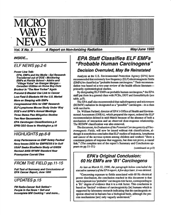
MWN May-June 1990

Free access to 23 years of detailed EMF/RF history:
Microwave News print edition, 1981-2003